IASS 2025
Travel Info

Mexico City

DISCOVER MEXICO CITY

Mexico City is the capital of the Mexican Republic and the political, cultural, and financial center of the country. It is the largest and most populous city in North America, and one of the most significant cultural capitals in Latin America.

More than seven centuries of history can be appreciated throughout its vast avenues — some of which trace the pre-Hispanic boulevards of ancient Tenochtitlan — and through its architecture, where layers of history coexist. Its dynamic urban life reflects multiple expressions of its traditional roots, evoking both indigenous and colonial legacies, while also showcasing refined artistic and architectural forms that embody modernity and the vibrant future of a growing metropolis.

Its pre-Hispanic remains attest to the greatness of the ancient city of Tenochtitlan, the capital of one of the most important and influential civilizations in Mesoamerica: the Mexicas (/meˈʃikas/), the original Nahuatl name for the Aztecs.

Colonial architecture, represented in Mexican Baroque and Neoclassical styles, exemplifies the blending of cultures, combining native craftsmanship with the grandeur of European construction to create distinctive and unique works. Across the city, one can find remarkable examples in elegant temples, historical residences, and former convents.

Picturesque neighborhoods such as Coyoacán, San Ángel, and Tlalpan preserve their unique charm and character, while Polanco, Juárez, Cuauhtémoc, Condesa, and Roma reflect the cosmopolitan and modern spirit of this Latin American metropolis — featuring galleries, restaurants, parks, cafés, and fondas (traditional eateries offering daily Mexican cuisine). The city showcases an extensive array of architectural styles, ranging from Art Déco, Spanish Colonial Revival, and Mexican Neocolonial to Functionalist and Modern movements, as well as distinctive structural and aesthetic projects from each decade of the second half of the 20th century and continuing into the 21st century.

For those who love art and history, Mexico City offers an extraordinary range of options — with over 188 museums, 64 theaters, 15 cultural centers, and 7 nearby archaeological sites.

Accommodation

IMPORTANT: Due to the change of venue, all previously published accommodation information has been updated. Please note that the new venue — the Faculty of Architecture  — is located in the southern part of Mexico City, approximately 16 km from the Historic Center.

If you booked accommodation before mid-May, we recommend canceling it as soon as possible and rebooking lodging closer to the new venue.

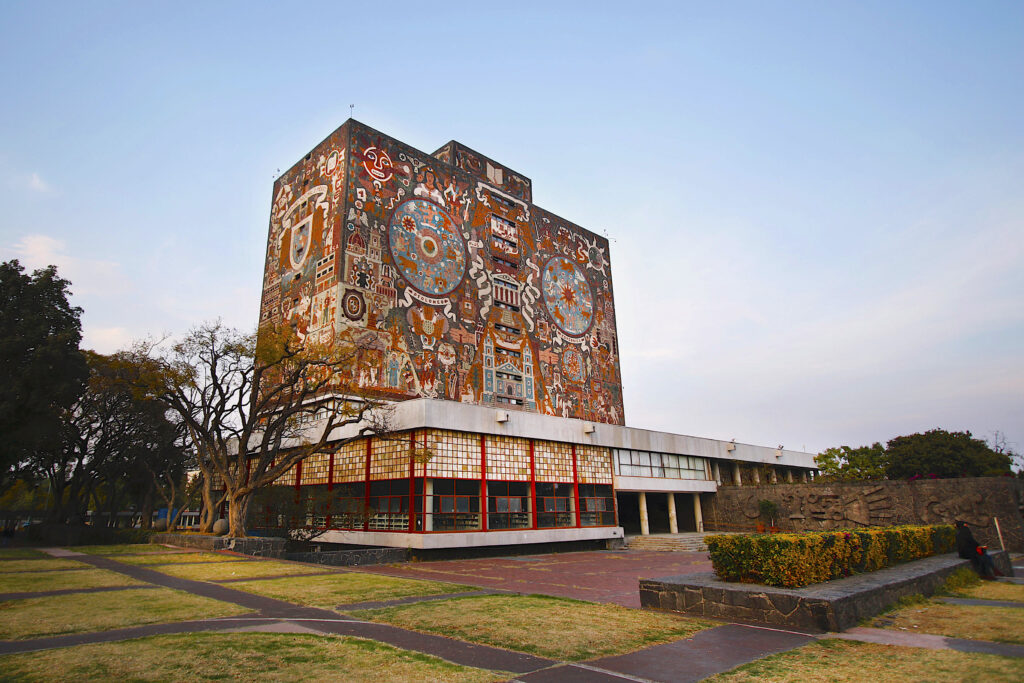
The Faculty of Architecture is located within the Central University City Campus of the Universidad Nacional Autónoma de México (UNAM), a vibrant and culturally rich area that attracts both national and international visitors throughout the year.

Please be aware that major events such as the Formula 1 Mexico Grand Prix (October 26) and Día de Muertos celebrations (November 1–2) will take place around the same dates. Therefore, high demand for accommodation is expected.

Note: Transportation between the Hotel Radisson Paraíso and Hotel Royal Pedregal and the Faculty of Architecture will be provided via special shuttle buses.

Official Symposium Hotel

Hotel Radisson Paraiso

* Transportation to the venue will be provided via special shuttle buses.

Nearby Option

Hotel Royal Pedregal

* Transportation to the Faculty of Architecture will be provided via special shuttle buses.

Nearby Option

Fiesta Inn Periferico Sur

Nearby Option

Hotel Camino Real Pedregal

Nearby Option

One Hotel Periferico Sur

You are also welcome to explore other lodging options available in the nearby neighborhoods.

Please note: Each participant is responsible for managing their own accommodation arrangements. The IASS 2025 Organizing Committee is not liable for any accommodation-related issues.

Upon Arrival

Mexico City has two international airports. The principal one is Mexico City’s International Airport Benito Juárez (AICM), located on the east side of the city, 16 km from the Central University City Campus and 5 km from the historical downtown. It is surrounded by urban areas and has two terminals.

The alternative is Felipe Ángeles International Airport (AIFA), located about 45 km north of the city.

HOW TO GET FROM MEXICO CITY'S INTERNATIONAL AIRPORT BENITO JUaREZ (AICM) / IATA CODE: MEX

👉 By Taxi or Car

The easiest and fastest way to travel from the airport is by taxi or car. You can reach the venue in about an hour without heavy traffic. Travel time can increase by 30 minutes or more during rush hour. Authorized taxi and car rental services operate inside the airport.

If you need a taxi, you can purchase a ticket after claiming your baggage at the authorized booths:

  • Terminal 1:

    • Domestic flights: Room A, outside Room A, and the domestic baggage claim area.

    • International flights: Lounges E2, E3, and Gate 10.

  • Terminal 2:

    • Domestic flights: Room D

    • International flights: Room E and Gate 4

The booths are marked with signs that say “Taxis Autorizados.”

Tell the clerk your destination. Fares depend on the city zone and type of vehicle (sedan, executive, or van). Payment is made in advance at the counter or ticket machine. You will receive a receipt or ticket, which can be paid by credit or debit card.

With your ticket in hand, follow the signs to the designated taxi area. The ticket guarantees a secure, authorized service—hand it to the driver when you get in. These taxis are safe and charge a fixed rate—no need to negotiate or worry about meters.

As an alternative, ride-hailing apps such as Uber, Didi, or inDrive can be used. Pickup points are outside the terminals, as these services are not allowed directly in the arrivals areas.

Please note: Street-hailed taxis are not recommended for tourists due to inconsistent safety and fare practices.

👉 By Metrobús

Metrobús Line 4 connects the airport to the historical downtown at a special rate. Both AICM terminals have a station. The ticket costs $30 MXN (approximately $1.64 USD).

Please note that to pay for Metrobús and other public transport systems, you need an Integrated Mobility Card (Tarjeta de Movilidad Integrada). This rechargeable smart card allows you to pay for nearly all public transportation services in Mexico City.

The Metrobús service operates daily from 5:00 a.m. to 12:00 a.m.

 👉 By Metro

Near AICM´s Terminal 1, you can access the Terminal Aérea Metro station on Line 5 (Yellow). Depending on your destination, multiple transfers may be required, not only between Metro lines but also to other public transport services. Note that a separate payment is needed for each transfer.
HOW TO GET FROM FELIPE ANGELES INTERNATIONAL AIRPORT (AIFA) / IATA CODE: NLU

As a recently constructed airport located far from the city, AIFA is more difficult to reach. The easiest way to travel is by car. Taxi services are available, and buses operate from the airport to various points in Mexico City. Travel time can range from 1.5 to 2 hours, or longer during rush hour.

For all the practical Mexico City’s public transpostation details, click the buttom billow:

Discover The Faculty of Architecture (FA) and Central University Campus of UNAM

HOW TO GET TO THE IASS 2025 VENUE: THE FACULTY OF ARCHITECTURE OF UNAM

👉 By Taxi or Car

It is easy to reach the Faculty of Architecture by car, as it is located on Circuito Escolar (Scholar Circuit Road) inside the Central Campus, which connects to major avenues such as Insurgentes Sur.

From any of the recommended hotels, you can reach the venue in less than 20 minutes when traffic is light, although travel time may increase during rush hours.

👉 By Metrobús

Metrobús Line 1 runs along Insurgentes Avenue, which passes through the UNAM campus, with three nearby stations: “Doctor Gálvez,” “Ciudad Universitaria (CU),” and “Centro Cultural Universitario.” However, the nearest stations are about a 20-minute walk from the Faculty of Architecture.

If you arrive at the “Ciudad Universitaria (CU)” station, you will need to cross the campus sports fields; if you arrive at “Doctor Gálvez”, you will walk through the central fields of the campus.

👉 By Metro

The most convenient way to reach the Faculty of Architecture by Metro is on Line 3 (Olive Green), which runs between the north of the city (Indios Verdes) and the south (Universidad). The Universidad station is located at the edge of the campus and is about a 30-minute walk from the Faculty of Architecture.

As an alternative, Copilco station (the stop before Universidad) is often preferred by students, since it is closer—about a 15-minute walk to the Faculty.

👉 By PumaBús

PumaBús is a free and safe internal transportation service provided by the University. It allows both members of the University community and visitors to reach faculties, institutes, and cultural facilities through 13 routes, plus an express line.

The main terminals for this service are the Universidad Metro station, the Ciudad Universitaria (CU) Metrobús station, and the CU Olympic Stadium.

Several routes stop directly at the Faculty of Architecture, while others have nearby stops within walking distance (watch the PumaBús map here).

The Organizing Committee of the IASS 2025 Mexico City Symposium expresses its sincere gratitude to all participants, speakers, sponsors, volunteers, and institutions who made this event possible.

The success of the IASS 2025 Mexico City Symposium has been the result of the collective effort, enthusiasm, and commitment of professional teams—both administrative and technical—and of a truly engaged academic community devoted to advancing the field of shell and spatial structures. Your presence, ideas, and collaboration have transformed this symposium into an unforgettable experience of exchange, learning, and friendship.

Thank you for sharing these inspiring days with us in Mexico City. We hope that the memories, knowledge, and connections built here will continue to strengthen our community in the years to come.

Welcome to Mexico City. Welcome to IASS 2025.
¡Mi casa es tu casa!

Organizing Committee of the IASS 2025 Mexico City Symposium

¡Mi casa es tu casa!